Do I need a guide to visit Khao Yai National Park?
Before setting out on a route in Khao Yai National Park, it is advisable to find out whether an escort is required. Contact the park's information center to register and obtain permits. Some trails require the mandatory presence of a guide for your safety.
Information about the available routes and the requirements for completing them is provided at the information center. Check whether independent trekking is possible on the direction you have chosen. Ignoring the rules can lead to access problems or create dangerous situations.
Price affordability 7.5/10 Wow factor 8/10 Safety 7/10 Physical difficulty 6.5/10 Historical value 5/10 Family friendliness 8.5/10 Transfer 4/10 Comfort 6/10
How much time should I spend in Khao Yai National Park?
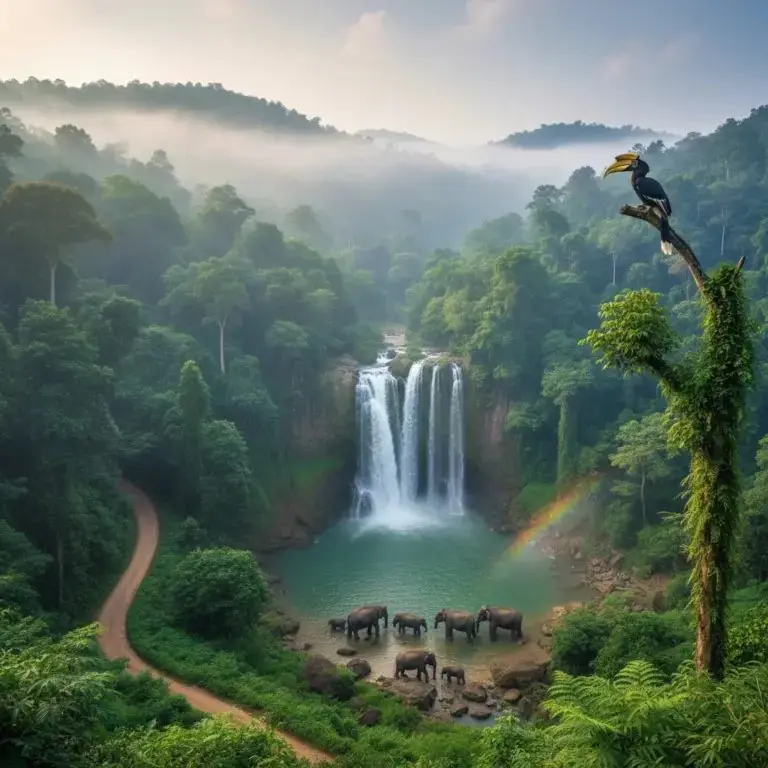
It is recommended to devote at least 3 days to Khao Yai National Park. This will allow you to experience its natural beauty more fully and increase your chances of encountering wildlife. Although there are no guarantees, gibbons, deer, hornbills, a variety of birds, macaques and possibly even elephants live here. The abundance of greenery and the picturesque landscapes of the park will not leave you indifferent. Spend enough time here to truly absorb the atmosphere of this unique place.
Do you have to pay to visit Khao Yai National Park?
Yes, you have to pay to visit Khao Yai National Park in Thailand, and this fee is collected upon entering the park territory or at the ticket booths along the trails, viewpoints and tourist routes. The national park is a protected natural area, and the fees go toward maintaining the infrastructure, protecting nature, providing sanitary services and serving visitors.
The amount of the fee depends on several factors: the visitor's nationality, age and type of vehicle. As a rule, the entrance cost for foreigners is higher than for citizens of Thailand. There is also a separate fee for entering by car or motorcycle, and it is paid separately from the personal entrance tickets. Children usually receive a discount or may visit the park for free if they are under a certain age.
Adult foreigners usually pay a fixed amount for entry and then additionally pay a fee for transport if they enter in their own car or on a bike. For example, separate fees may apply to tourists who want to climb to certain viewing platforms, walk along hiking trails or visit natural attractions inside the park.
It is important to understand that payment is mandatory for all visitors, and entry without payment may be regarded as a violation. The ticket booths usually operate until late morning or during daylight hours, so it is better to arrive early to avoid queues and to be able to pay for entry without delays.
The entrance fees are often updated, so before the trip it is advisable to check the current prices on the park's official website or with local tour operators. But in any case, you should plan your budget for the visit taking these mandatory payments into account. Khao Yai National Park is one of the most popular nature parks in Thailand, and the entrance fee helps preserve its rich flora and fauna, maintain safety on the trails and provide amenities for tourists.
Is one day enough to visit Khao Yai?
Visiting Khao Yai in one day is possible, but it is not optimal. Such a format will provide only a first acquaintance with the unique nature of the national park. Although Khao Yai is known as an excellent place for wildlife watching, success in this area within such a short time depends on a significant amount of luck. For a more complete immersion in the atmosphere and the opportunity to see more wild animals, it is recommended to set aside more time.
Are tourists allowed in Khao Yai National Park?
Yes, tourists are allowed to visit Khao Yai National Park. It is open to foreign guests and is one of the most popular nature parks in Thailand. Upon entry you must pay an entrance ticket and also follow the park's rules, since this is a protected natural area.
Visitors can independently walk along the marked trails, visit waterfalls, viewing platforms and animal-watching areas. Excursions with rangers are also available. It is important to remember the safety rules, not to feed wild animals and not to leave the official routes.
The park is open daily during daylight hours, so tourists can freely plan a one-day trip or stay at a campsite within the territory.
What is special about Khao Yai?
Khao Yai National Park stands out among other places in Thailand for its exceptional role in preserving biodiversity.
The unique conditions of the park ensure the presence of the greatest variety of animal species in the country.
Thanks to the rich sources of food, charismatic inhabitants are often encountered here.
Among them: wild elephants, gaurs, wild dogs, muntjacs, sambars, gibbons, hornbills and macaques.
Khao Yai's appeal to nature lovers is due to the high probability of observing many of these species.
This makes the park an ideal destination for active tourism and immersion in wild nature.
What is Khao Yai known for?
Khao Yai is an iconic national park of Thailand, founded in 1962. Its special significance is confirmed by the park's status as an ASEAN Heritage Park since 1984 and its inclusion in the prestigious UNESCO World Heritage list in 2005. These recognitions emphasize the uniqueness and value of the park.
The climatic conditions of Khao Yai are characterized by a mild average annual temperature of about 21°C. The hottest period falls in April, when the thermometer can reach 27°C, creating comfortable conditions for a visit.
Why is Khao Yai National Park recognized as a park that is part of the ASEAN nature conservation zone?
Khao Yai National Park is recognized as an ASEAN cultural heritage site. Such status is awarded to particularly important nature conservation zones that reflect the unique ecosystems of the region. The process of nominating and evaluating candidates is carried out at the intergovernmental level. The governments of the ASEAN member states submit applications for consideration.
Next, the ASEAN member states conduct a thorough assessment of the submitted candidates. The goal is to identify natural sites of exceptional ecological value and significance for the entire Asian region. Khao Yai meets these strict criteria, which served as the basis for its inclusion in the list.
Year of foundation In what year the site was erected or founded 1962 Duration Recommended time for the visit 6 h. Temperature Average annual temperature +23 °C Area What territory the site occupies 2168 sq. km Tourist flow Number of tourists (thousand/day) 3 thousand
Why is it colder in Khao Yai?
The climate in Khao Yai remains tropical; however, the altitude above sea level and the mountainous terrain contribute to a lower temperature compared with the rest of the regions of Thailand.
The hottest period falls in the months of March, April and May. This time is characterized by high temperature and humidity.
Then comes the rainy season, which usually lasts from June to October.
Although the temperature remains tropical, the mountainous terrain of Khao Yai naturally lowers the average temperature, making it more comfortable.
The mountain ranges of Khao Yai affect air circulation, creating a «cooling» effect, especially in the upper parts.
Thus, the combination of the tropical latitude and the mountainous landscape produces a cooler microclimate.
Route to the place: Khao Yai National Park, Pak Chong Go
What does the word khao yai mean in the Thai language?
Khao Yai translated from Thai means «big mountain».
This name refers to a picturesque area located in the Sankamphaeng mountain range, Thailand.
This region is now known as Khao Yai National Park.
This place attracts travelers with its impressive nature and mountain landscapes.
The uniqueness of the name emphasizes the scale and majesty of this natural site.
Phu Khao Khuai National ParkReserve on EarthHow to get to Khao Yai National Park from the nearest tourist towns of Thailand?
Khao Yai National Park is one of the most popular nature reserves in Thailand, located 150–200 km northeast of Bangkok. It is part of a UNESCO World Heritage site and is known for its rich fauna, waterfalls and caves. The nearest tourist towns and resorts for the trip are: Bangkok (the capital, the main hub), Pak Chong (a suburban town 30 km from the park) and Nakhon Ratchasima (Korat, the center of Isan, 100 km away).
From Bangkok
This is the most convenient and popular route for tourists. The distance is about 180 km, travel time 2.5–3 hours by car.
- Bus: Regular services from the Northern Bus Terminal (Mo Chit) or the Eastern Bus Terminal (Ekkamai) to Pak Chong (minivans or buses, price 100–150 baht, 2 hours). From there a taxi or songthaew to the park entrance (200–500 baht).
- Tour: Organized tours from Bangkok include transfer, a guide and entrance to the park. Cost from 1500 baht/person. Book on Klook or TripAdvisor.
- Car rental/taxi: Rent a car in Bangkok through Avis or a Grab taxi (4000–6000 baht round trip). Along Route 2 (Mittraphap Road), then 2090 to the park.
- Train: To Pak Chong station (2 hours, 30–100 baht), then a transfer (rarely used).
The best time is early morning, to avoid traffic jams on Friday through Sunday.
From Pak Chong
Pak Chong is the nearest hub with hotels and markets, ideal for an overnight stay before the park (20–40 min by taxi).
- Songthaews (red pickups) from the market to park gates No. 1 or No. 2 (50–100 baht/person, run frequently during the day).
- Motorcycle taxi or tuk-tuk (100–200 baht).
- Bike rental (200–300 baht/day) on site — convenient for independent sightseeing.
Park ticket: 400 baht for foreigners, children 200 baht. Buy on the official DNP website.
From Nakhon Ratchasima (Korat)
The distance is 90 km, travel time 1.5 hours. Suitable for tourists of Isan.
- Bus: From the Korat terminal to Pak Chong (50 baht, 1 hour), then a transfer.
- Train: To Pak Chong from Korat station.
- Taxi or car rental along Route 2.
Useful tips
Aspect Details Best season November–February (dry, cool) Park opening hours 6:00–18:00, closed in rain What to bring Repellent, water, comfortable shoes, binoculars for animals Where to stay overnight In the park (guest house, campsite) or Pak Chong (Booking.com) Excursions Elephant trail, night safari (800–1500 baht)Check the current prices and schedule on the official websites. For up-to-date weather and roads use Google Maps. Avoid solo walks in the jungle — only with a guide!
Phu Khao Khuai National Park on the map of Earth — Yandex MapsFrequently asked questions (FAQ)
What is Khao Yai National Park and how do you get there from Bangkok?Khao Yai is the largest and one of the most famous national parks in Thailand, located about 2-3 hours' drive from Bangkok. You can get there by taxi, rental car or minivan from Bangkok.
What sights are worth seeing in Khao Yai besides nature?In addition to the picturesque waterfalls (for example, Haew Suwat), viewing platforms and hiking trails, the vineyards, animal farms, theme parks and restaurants with panoramic views in the vicinity of the park are popular.
When is the best time to visit Khao Yai National Park?The best time to visit Khao Yai is the cool and dry season from November to February. During this time the weather is most comfortable for walks and wildlife watching.
What kinds of animals can you encounter in Khao Yai?The park is home to many species of wild animals, including elephants, deer, gibbons, bears, as well as more than 300 species of birds. The chances of seeing them are higher at dawn and sunset.