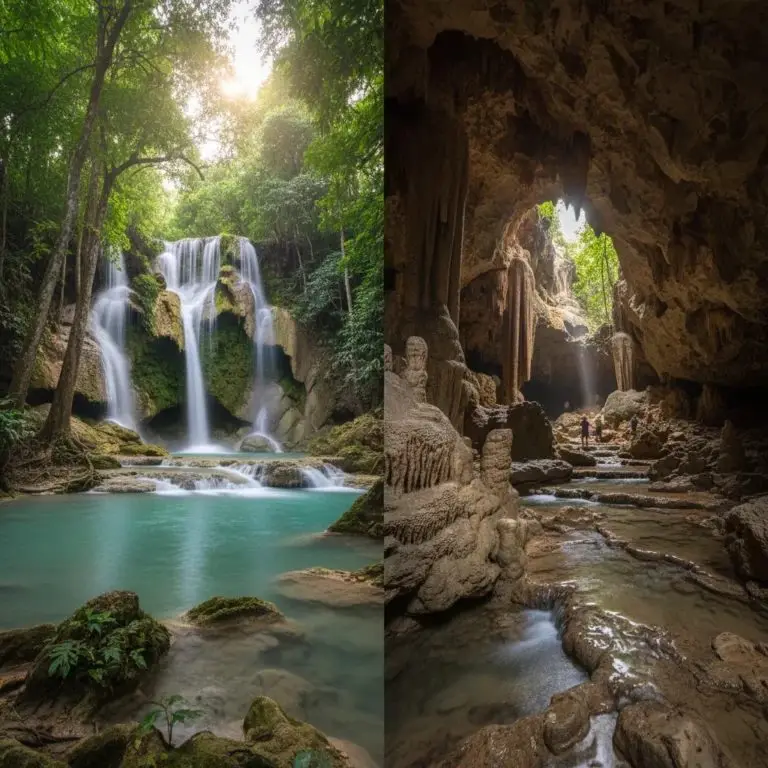
Imagine: you are planning your perfect holiday in Thailand, and a world of incredible natural wonders opens up before you. What will you choose – crystal-clear turquoise cascades where you can swim carefree amid the wild, or a mysterious, majestic cave inside which a temple gleams, bathed in rays of sunlight? It is precisely such a difficult choice that confronts many travellers when it comes to two gems of central Thailand: the legendary Erawan Waterfall and the mystical Phraya Nakhon Cave.
Both of these places regularly top the lists of the most popular excursions beyond the noisy resorts, promising unforgettable experiences and unique photographs. However, despite their shared appeal as natural attractions, they offer a completely different experience. Many tourists, especially those who book a comprehensive tour and have limited time, face a dilemma: what to spend a precious day on? Our detailed comparison will help you understand precisely which of these amazing natural wonders matches your particular expectations of a trip to Thailand.
Who will you choose?
Erawan Waterfall VS Phraya Nakhon Cave You have already voted. Thank you! Erawan Waterfall 50% Phraya Nakhon Cave 50%Pros and cons: Erawan Waterfall
✅ Pros- Stunning natural beauty
- The chance to swim in the cascades
- Different difficulty levels available for the climb
- It can get crowded
- Physical fitness is needed for the full tour
- In the rainy season the waterfalls may be less impressive
Pros and cons: Phraya Nakhon Cave
✅ Pros- A unique blend of nature and architecture
- An unforgettable spectacle with rays of sunlight
- Historical and spiritual atmosphere
- Requires climbing stairs
- It can be hot and humid
- Accessibility depends on the time of year and weather conditions
Erawan vs. Phraya Nakhon: A guide to the perfect choice
If you want to immerse yourself in pristine nature and waterfall cascades, choose Erawan Waterfall. But if you are drawn to unique architecture and breathtaking views from the cave ceiling, then Phraya Nakhon Cave will be your best choice.
Comparison: Erawan Waterfall and Phraya Nakhon Cave
Criterion Erawan Waterfall Phraya Nakhon Cave Vibe/Atmosphere Natural, refreshing Mystical, majestic Season (best months) November–February November–March Beaches (characteristics) None (natural pools) Small, secluded (Laem Sala) Budget $$ $$$ Who it suits Families, Couples Couples, Travellers Accessibility Medium (bus/taxi) High (to the park, boat/trek, then climb)Clash of the Titans: Erawan Waterfall versus Phraya Nakhon Cave – Where to spend your money?
If your goal is to get the most out of your trip on a limited budget, then the choice between the picturesque Erawan Waterfall and the majestic Phraya Nakhon Cave becomes a real puzzle. Unlike Erawan, where you pay for the right to enjoy nature in stages – each level of the waterfall has its own «price» of entry (included in the overall national park ticket) – Phraya Nakhon Cave offers a more unified cost structure. For example, entry to Erawan National Park for tourists from other countries will cost around 300 baht, plus possible additional expenses for transport to the park. Whereas visiting Phraya Nakhon Cave, located in the picturesque Khao Sam Roi Yot National Park, also requires an entry fee (about 200 baht), but the main expense here is renting a boat to the island (approximately 100–200 baht round trip, depending on the number of people), as well as, if you wish, the services of a local guide.
In terms of food, both places offer options, but with varying degrees of «exclusivity» and, accordingly, pricing policy. Within Erawan National Park you will find several food outlets where you can satisfy your hunger, but be prepared for prices that may be somewhat higher than in ordinary cafes outside the park. On the upside, here you can grab a bite while admiring the views of the cascades. As for Phraya Nakhon Cave, the food infrastructure on the island itself is minimal. Most likely, you will have to take care of provisions in advance or rely on the modest selection of snacks sometimes offered by the boatmen. In this respect, Erawan wins on convenience but loses on potential cost. While here, at Erawan, it can be a little crowded in season and you encounter traces of tourists, there, on the island with the cave, the atmosphere is more secluded but also demands greater self-reliance.
Transport accessibility also plays a role in shaping the final cost of the trip. Erawan can be reached both by rented transport and by public bus from the town of Kanchanaburi, which makes it more accessible for independent travellers. Phraya Nakhon Cave, being on an island, requires a trip to the pier and then a water taxi. This option certainly adds a «twist» to the journey, but it can increase overall costs, especially if you are travelling alone. Both places offer unforgettable experiences, but in terms of budget, Erawan may turn out to be more predictable, whereas Phraya Nakhon requires more careful planning of transfers, or simply a more attentive approach to organising the logistics.
Beyond the ordinary: when nature works miracles
Atmosphere and impressions are two facets that make any journey truly unforgettable. Comparing Erawan Waterfall and Phraya Nakhon Cave, we plunge into completely different yet equally captivating worlds. Unlike the raging power and living energy of Erawan, where every cascade delights the eye and refreshes the body, Phraya Nakhon offers something else – a mysterious, contemplative immersion in a realm of silence and light. If at Erawan you feel yourself part of wild, untameable nature, sensing the coolness of the spray and listening to the symphony of falling water, then at Phraya Nakhon you are enveloped by an aura of calm and grandeur, when the sun's rays, breaking through the cave's vaults, turn the stone halls into the stage of an ancient, silent play.
The wow effect at Erawan is achieved through the cascades, each of which is a unique creation of nature, with the chance to swim in crystal-clear pools. This is a place for the active and the adventure-hungry, where you can spend a whole day exploring all seven levels. Whereas the wow effect of Phraya Nakhon Cave lies in its hidden beauty and history. Imagine: you overcome a small climb, and before you opens a huge hall lit by sunlight pouring through an opening in the ceiling, and at its centre – a majestic temple. The atmosphere here is steeped in antiquity, tranquillity and incredible energy. This is a place where time seems to slow down.
Amenities and accessibility also play a role. Erawan Waterfall, being a popular national park, offers fairly developed infrastructure: trails, viewing platforms, rest areas. However, at peak season it can be quite crowded here, which somewhat reduces the sense of seclusion, and the hot tropical climate can add to the challenge of the climb. Phraya Nakhon Cave, in turn, requires a more deliberate approach. The path to it, including the boat ride and the walk uphill, is itself part of the adventure, but the reward – silence, grandeur and the chance to touch history – is often worth any effort. The value of each place is determined by your expectations: are you seeking a thrilling adventure with the chance to cool off, or do you strive for spiritual peace and contemplation?
Travel without hassle: choosing the best transfer to the waterfall or cave
Setting off to Thailand, many dream of seeing the picturesque Erawan Waterfall and the mysterious Phraya Nakhon Cave. However, before enjoying the beauty of nature, it is important to think through how to get there. Unlike the transfer to Erawan Waterfall, which often offers more standard and predictable routes, the trip to Phraya Nakhon Cave may require greater flexibility and adaptation. If you prefer a tried-and-tested, comfortable way of reaching your destination, opting for an organised tour to Erawan that includes air-conditioned transport and a clear schedule will be the more optimal choice. Whereas in the case of Phraya Nakhon, you may have to combine different modes of transport – from minivan to boat – which can add an element of adventure but at the same time requires readiness for possible delays and less predictable conditions.
As for comfort, duration and safety, here too significant differences emerge. The journey to Erawan Waterfall usually involves travel on modern buses or minivans, which guarantees a pleasant and safe road, often taking 2–3 hours one way. Drivers on such tours typically hold licences and follow the established traffic rules. Phraya Nakhon Cave, located not far from Hua Hin, can be reached in more varied ways. You can hire a private car that will take you to the pier and then switch to a boat. This option provides more independence, but the comfort level of the boat may vary, and the duration of the trip, including the transfer, may turn out to be less predictable. Safety on the water always demands extra attention, although the local boatmen usually observe all the necessary precautions.
Thus, for those who value predictability, a high level of comfort and the minimising of unforeseen situations, the transfer to Erawan Waterfall will most likely be more preferable. Modern vehicles, clearly planned routes and the absence of any need for additional transfers make this trip as convenient as possible. But if you are ready for minor difficulties, value the chance to manage your time independently and enjoy the process of exploration, the combined transfer to Phraya Nakhon Cave will give you a unique experience, where each stage of the way becomes part of the adventure in itself!
The verdict: Which adventure awaits you?
The choice between the majestic Erawan Waterfall and the mysterious Phraya Nakhon Cave depends solely on your individual preferences and on what you are looking for from your journey. Both places offer unique experiences, but each is geared towards a particular type of explorer.
If your soul craves refreshment, physical activity and breathtaking natural scenery, then your choice is obvious. However, if you are above all seeking spiritual peace, historical significance and the chance to touch something truly sacred, then the other place will be ideal for you. In the end, the best choice is the one that resonates with your personal desires and expectations of the trip.
- Choose Erawan Waterfall if you love active recreation, are looking for the chance to swim in picturesque natural waters, are ready for walks along scenic trails and want to enjoy stunning cascades and emerald pools. This option is ideal for families with children, nature lovers and those who want a boost of energy and positive emotions.
- Choose Phraya Nakhon Cave if you are interested in history and culture, appreciate unique architectural structures, strive for a place with a special atmosphere and are ready to walk a short but scenic path to see a mesmerising spectacle. This is a place for those who seek tranquillity, the impression of man-made beauty in a natural setting, and want to feel something mystical.
Frequently asked questions (FAQ)
Which to choose: the waterfalls of Kanchanaburi or the caves of Hua Hin?The choice depends on your preferences: Kanchanaburi offers lush nature and multi-tiered waterfalls, ideal for swimming and trekking. Hua Hin will surprise you with unique karst caves, some of which conceal majestic temples, offering a more mystical and cultural experience.
What are the waterfalls of Kanchanaburi famous for?Kanchanaburi is renowned for its scenic national parks, such as Erawan and Sai Yok Noi, home to cascading waterfalls with emerald ponds. Erawan Waterfall in particular is known for its seven levels, each of which offers unique pools for swimming.
Which caves are worth visiting in Hua Hin?The most famous cave in Hua Hin is Phraya Nakhon, located in Khao Sam Roi Yot National Park. Inside it stands the royal Kuha Karuhas pavilion, lit by sunlight through an opening in the ceiling, creating an unforgettable spectacle.
Is it possible to visit the waterfalls of Kanchanaburi and the caves of Hua Hin in one trip?Yes, it is possible, but it will require careful planning because of the considerable distance (200–250 km) between the locations. It is recommended to set aside at least one full day for each attraction and to consider an overnight stay in each region to avoid rushing.
Which is better for a family holiday: Kanchanaburi or Hua Hin?Both options are suitable for families. Kanchanaburi with its waterfalls offers active recreation in nature, swimming and picnics. Hua Hin, in addition to caves, has beaches, water parks and less extreme entertainment, which may be preferable for families with small children.
How do you get to Erawan Waterfall from Bangkok?You can reach Erawan Waterfall by bus from Bangkok's Southern Bus Terminal to Kanchanaburi, and then switch to a local bus or taxi to the park. Organised excursions from Bangkok that include transfer and a guide are also available.
Which cave in Hua Hin is the most famous/photogenic?Without doubt, it is Phraya Nakhon Cave in Khao Sam Roi Yot National Park. Its uniqueness lies in two karst sinkholes through which sunlight enters, illuminating the elegant royal Kuha Karuhas pavilion, making it incredibly photogenic.
What else is there to see near the waterfalls of Kanchanaburi?Near the waterfalls of Kanchanaburi you can visit the Bridge over the River Kwai, the World War II Museum, the Allied war cemetery, and ride the ‘Death Railway’. The Hin Dat hot springs and Krasae Cave are also popular.
What else is there to see in the surroundings of Hua Hin, besides the caves?Besides the caves, in Hua Hin it is worth visiting the night markets, Maruekhathaiyawan Palace, Hua Hin Railway Station, Monkey Hill (Khao Takiab) and the water parks. Vineyards and floating markets are also popular.
When is the best time to go to the waterfalls in Kanchanaburi?The best time to visit the waterfalls of Kanchanaburi is the dry season from November to February, when the weather is cooler and more comfortable for trekking. The waterfalls are full but not so much that the trails are dangerous, and the water in the pools is clear.
Is special preparation needed to visit the caves of Hua Hin?Visiting Phraya Nakhon Cave will require a little physical preparation, since the route includes a climb up a mountain trail and a descent into the cave. Comfortable footwear, drinking water and a hat are recommended.
How long does a visit to Erawan Waterfall take?Visiting all seven levels of Erawan Waterfall usually takes from 3 to 5 hours, depending on your pace and the time spent swimming at each level. Also factor in the time for the journey to the park and back.
Are there guides or excursions to the caves of Hua Hin?Yes, numerous group and individual excursions to the caves of Hua Hin, especially to Phraya Nakhon, are organised from Hua Hin. Many hotels and local travel agencies offer such tours, often including transfer and entrance tickets.
Where is it better to stay: in Kanchanaburi or Hua Hin?If your priority is nature and active recreation, choose Kanchanaburi, where there are many hotels and guesthouses on the river. For a beach holiday, cultural attractions and developed tourist infrastructure, Hua Hin with its wide selection of accommodation is the better fit.