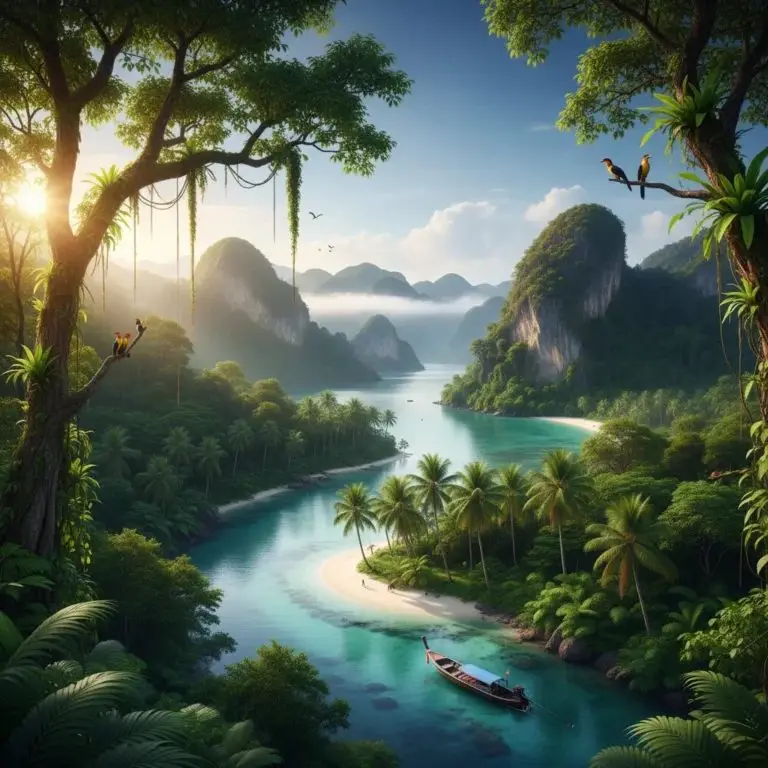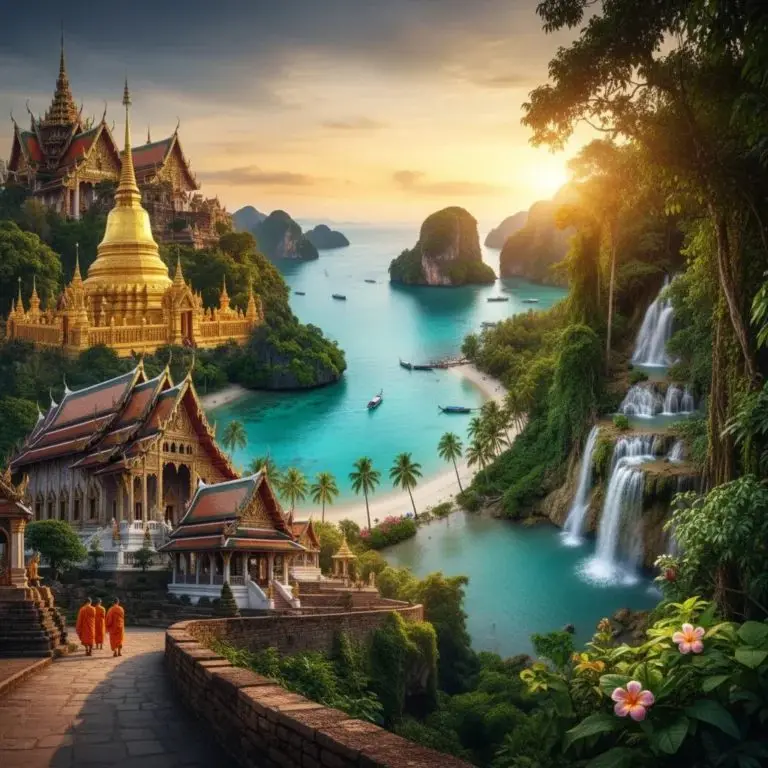
Thailand is a country that cannot be described in a single word. For some it is the golden temples of Bangkok, the scent of jasmine and the noise of tuk-tuks. For others it is islands with turquoise-coloured water, white sand and long-tail boats by limestone cliffs. And someone remembers the northern mountains, rice fields, ancient capitals and small markets, where the morning begins with coconut milk, fruit and smiles.
I would put it this way: it is better not to "look at" Thailand, but to live it. Here it is important not only to tick off the famous places, but also to give yourself time to feel the rhythm of the country. In the morning - a temple and the aroma of incense, in the afternoon - street noodles, in the evening - a sunset on the beach, and the next day - the road into the jungle or to ancient ruins. Below are ten places that can be called the true pearls of Thailand: from cultural symbols to tropical paradise corners.
1. Bangkok: a city of palaces, temples and endless energy
Bangkok often becomes the first encounter with Thailand - noisy, vivid, a little chaotic, but incredibly alive. Here skyscrapers stand side by side with ancient temples, boats glide along the canals, and street food can turn out to be tastier than a restaurant dinner.
The main classic of Bangkok is the Grand Palace and the Temple of the Emerald Buddha. The Grand Palace is located in the historic heart of the city and, from 1782, was the official residence of the kings of Siam, and then of Thailand. This place is worth visiting unhurriedly: examining the mosaics, the roofs, the golden details and the strict ceremonial beauty of the complex.
But Bangkok is not only palaces. It is the dawn by Wat Arun, the reclining Buddha in Wat Pho, the evening Chinatown, the markets, shopping centres, river ferries and small cafes hidden in the side streets. To feel the city, do not limit yourself to a single excursion. Take a ride along the Chao Phraya River, try mango with sticky rice, look in on a night market and, at least once, simply walk without a plan.
Bangkok suits those who love contrasts: antiquity and modernity, luxury and simplicity, temples and nightlife, noisy streets and the quiet courtyards of the monasteries.
2. Ayutthaya: an ancient capital among ruins and heads of Buddha
Ayutthaya is a journey into the past. Once it was the mighty capital of the Siamese kingdom, and today it attracts travellers with ancient temples, brick stupas, statues of Buddha and an atmosphere of grandeur that has survived the centuries.
It is convenient to come here from Bangkok for a single day, but it is better to linger at least for a night. In the morning, when there are still few tourists, the ruins look especially beautiful: a soft light falls on the old walls, monks pass by the temples, and the city wakes up unhurriedly.
One of the most famous spots is the head of Buddha, entwined in the roots of a tree, in the temple of Wat Mahathat. But the true magic of Ayutthaya is not only in a single photograph. It is in the walks between the temples, in a bicycle ride through the historic park, in the feeling that every brick here remembers history.
Ayutthaya is an ideal pearl for those who want to add a little culture and depth to a beach itinerary.
3. Sukhothai: the place where the Thai soul was born
If Ayutthaya impresses with its scale, then Sukhothai conquers with its tranquillity. This is one of the most beautiful historic locations of Thailand, where the ruins of the ancient city are surrounded by ponds, lotuses, green lawns and a wide sky.
Sukhothai is often called the cradle of Thai civilisation. It is good not to hurry here: take a bicycle, ride through the historic park, stop by the statues of Buddha, sit by the water and feel how soft and contemplative history can be.
Unlike Bangkok and the popular islands, Sukhothai is usually not overloaded with tourist bustle. This is a place for a quiet journey, for beautiful sunrises, for photographs without a crowd and for those who want to see Thailand not only as a beach destination, but also as a country with a deep cultural memory.
4. Chiang Mai: the northern capital of temples, mountains and crafts
Chiang Mai is a completely different Thailand. There is no sea horizon here, but there are mountains, misty mornings, old city walls, craftsmen's markets and dozens of temples. This is a city where it is easy to slow down.
One of the main shrines of the region is the temple of Doi Suthep, located on a mountain above the city. From there a view of Chiang Mai opens up, especially beautiful in clear weather. But the value of Chiang Mai is not only in its individual sights. You want to live it through the details: a morning coffee in the old town, an evening market, a master class in Thai cuisine, a conversation with local craftsmen, a trip to the waterfalls or to the mountain villages.
Chiang Mai suits well those who are tired of the beach heat and want to see a softer, more cultural and creative side of Thailand. You can spend three days here, or you can stay for a month - and still find something new every day.
5. Phuket: the gateway to the Andaman Sea
Phuket is often perceived as a beach resort, but in fact it is a whole island with different characters. Patong is noisy and energetic, Kata and Karon are more suitable for a beach holiday, Nai Harn is calmer, and the Old Town of Phuket delights with colourful houses in the Sino-Portuguese style, cafes and street art.
Phuket is convenient because from here it is easy to set off on sea excursions: to the Phi Phi islands, to Phang Nga Bay, to the Similan islands or to Coral Island. Therefore it can be regarded not only as a place for a holiday, but also as a base for exploring the south of Thailand.
To see Phuket in all its dimensions, it is worth combining the beaches, viewpoints, the Old Town, the evening markets and at least one sea trip. Then the island reveals itself not as simply a "resort with hotels", but as a rich destination, where you can alternate lazy days and active adventures.
6. The Phi Phi islands: a postcard that became reality
Phi Phi is one of the most recognisable places of Thailand. Turquoise water, vertical limestone cliffs, bays, boats, snorkelling and the famous Maya Bay have made these islands a symbol of tropical paradise. The official tourism portal of Thailand singles out Koh Phi Phi as one of the country's popular destinations, and the islands themselves have long become an obligatory point for many travellers across the Andaman Sea.
But to Phi Phi it is better to go with the right expectations. This is not a secluded secret island, but a very popular place. There can be many tourists here, especially in high season. Therefore the best advice is to choose an early departure, look carefully at the programme and not try to see everything at too fast a pace.
The main value of Phi Phi is the beauty of the water and the dramatic landscapes. Even if you have seen hundreds of photographs, in real life the lagoons and cliffs still make an impression. This is a place for those who want a vivid day at sea, snorkelling, beautiful shots and the feeling that Thailand really can look like the cover of a guidebook.
7. Krabi and Railay: cliffs, beaches and freedom without roads
Krabi is one of the most picturesque destinations of southern Thailand. Railay stands out especially - a peninsula that you cannot simply reach by car: because of the limestone cliffs, people usually get here by boat. The Tourism Authority of Thailand describes Railay Beach as an outstanding beach with beautiful limestone cliffs; the territory is divided into several parts, including Railay West.
Railay is good because it has the feeling of a separate world. The boat approaches the shore, you step onto the sand - and it is as if you find yourself in a natural amphitheatre of cliffs. Here you can swim, walk between the beaches, meet the sunsets, do rock climbing or simply sit by the water and watch how the long-tail boats return to the shore.
Krabi and Railay will especially appeal to those who want to combine a beach holiday with beautiful nature, but without too noisy a resort atmosphere. This is the south of Thailand in a more relaxed, romantic and cinematic rendition.
8. Khao Sok: jungle, Cheow Lan Lake and nights on the water
Khao Sok is one of the most amazing natural pearls of Thailand. This place is not at all like the beach islands: here there are humid tropical forests, limestone mountains, caves, rivers, the sounds of the jungle and Cheow Lan Lake with houses on the water.
The Thai National Parks website notes that among the main attractions of Khao Sok are the floating hotels on Cheow Lan Lake, the wildlife, the viewpoints, the limestone hills, waterfalls, trails, caves and the Sok River. The national park was founded in 1980 and occupies a territory in Surat Thani province.
Khao Sok is an ideal place to add an adventure to your itinerary. Here you can spend the night in a floating bungalow, wake up to the sounds of nature, set off by boat across the lake, see the mist over the water and feel a completely different Thailand - wild, green, deep.
This destination is especially suitable for those who want to rest from beaches and cities, love nature and are not afraid of humidity, insects and simple conditions. The reward is some of the strongest impressions in the country.
9. Samui: the soft island rhythm of the Gulf of Siam
Samui is an island for those who want the tropics, but without excessive bustle. There are different zones here: the lively Chaweng, the calmer Lamai, cosy bays, coconut palms, beach cafes and beautiful villas on the hills.
Samui is well suited for a measured holiday. In the morning you can swim, in the afternoon travel to waterfalls or temples, in the evening dine by the sea. If you want activity, nearby are Koh Phangan and Koh Tao, where you can set off for a few days or on an excursion.
Unlike the Andaman coast, Samui is located in the Gulf of Siam, so the seasonality here may differ from Phuket and Krabi. This is important to take into account when planning a trip: sometimes, when it is raining on one side of Thailand, the other may be more comfortable.
Samui is a good pearl for couples, families, independent travellers and those who seek a balance between infrastructure and island relaxation.
10. Koh Lipe: a small tropical paradise in the south
Koh Lipe is one of those islands that people go to for clear water, white sand and the feeling of the "edge of the map". It is located in the south of Thailand, not far from the maritime border with Malaysia, and is often perceived as a more intimate alternative to the large resorts.
There are only a few main beaches here, but each with its own mood. Pattaya Beach is convenient for the arrival of boats and for life near the infrastructure, Sunrise Beach is good for the morning light and quiet walks, Sunset Beach - for sunsets and a more lazy rhythm.
Koh Lipe is especially loved for its snorkelling and the colour of the water. In good weather the sea here seems almost unreal: transparent, glowing, with shades from blue to a rich turquoise. But it is important to remember: the island is small and popular, so in high season it is better to book accommodation in advance, and to treat nature with care.
Koh Lipe is a pearl for those who are ready to travel a little longer for the feeling of a true tropical escape.
How to gather these pearls into a single journey
If you are going to Thailand for the first time, do not try to cover everything in a single trip. The country seems compact on the map, but the journeys between the north, the centre and the islands require time. A good itinerary for 10-14 days might look like this: Bangkok, Ayutthaya, Chiang Mai and then one beach region - for example Phuket with Phi Phi or Krabi with Railay.
If you want more nature, add Khao Sok between the north and the sea or between Phuket and Samui. If the goal is an island holiday, choose one side: the Andaman Sea with Phuket, Krabi, Phi Phi and Koh Lipe, or the Gulf of Siam with Samui, Phangan and Koh Tao.
The main thing is not to turn the journey into a race. Thailand reveals itself in the pauses: in a cup of cold Thai tea, in a conversation with a boatman, in the evening temple chime, in the road between the palms, in the moment when you first see the sea after a long journey.
These ten pearls are different: Bangkok gives energy, Ayutthaya and Sukhothai - history, Chiang Mai - the culture of the north, Phuket - convenience and itineraries, Phi Phi and Railay - postcard beauty, Khao Sok - wild nature, Samui - a soft island rhythm, Koh Lipe - the feeling of a small paradise. Together they show the main thing: Thailand cannot be reduced only to beaches or temples. Its strength is in its diversity, and that is precisely why you want to return here.