What is the history of the city of Mae Hong Son?
The history of the city of Mae Hong Son traces its beginnings to the early 19th century. The settlement was founded by order of the ruler of Chiang Mai as a strategic camp intended for training elephants. Thanks to its location in hard-to-reach mountainous terrain, the city long remained isolated from the rest of the country. In the following centuries, this region preserved its unique authenticity and close cultural ties with neighboring Myanmar. Despite its rich history and natural beauty, as of 2012 Mae Hong Son was officially considered the poorest province of Thailand. The economic development of the region was historically complicated by the difficult terrain, which influenced its modern status.
Price affordability 7/10 Wow factor 8.5/10 Safety 8/10 Physical difficulty 6/10 Historical value 7/10 Family accessibility 7/10 Transfer 4/10 Comfort 6.5/10
What is the climate like in Mae Hong Son?
In the province of Mae Hong Son, tourists are met by a mountainous northern Thai climate: on the whole it is tropical, but due to the terrain it feels milder and cooler than in central Thailand. The region is characterized by three clear periods: a cool and dry season, a hot season, and a rainy season. According to the climatic classification, this is a tropical savanna climate, in which the summer-autumn months are significantly wetter than the winter ones; the average annual temperature is about 23.9 °C, and the annual amount of precipitation is approximately 1338 mm.
The most comfortable time for most travelers is from November to January, and especially December–January: during this period the weather is the most pleasant for walks, trips through the mountains, and to viewpoints. The official tourism website of Thailand directly states that December and January give the coolest and most pleasant weather. On average, in December the daytime temperature holds at about 29 °C, the nighttime around 15.4 °C; January too remains quite mild, with warm days and noticeably fresher mornings and evenings.
March and April are the hottest period. April is usually the peak of the heat: the average daytime temperature rises to about 38.7 °C, and the nighttime to 22.5 °C. In these months there is a lot of sun, the air is drier, but it is precisely in the warm season that a haze often appears in the valleys of Mae Hong Son, because of which the sky may look grayish, and distant views less distinct. For the tourist this means beautiful but in places hot and not always perfectly clear weather.
The rainy season is usually felt from May to October. According to WeatherSpark, the wettest period lasts approximately from early May to mid-October, and August is the rainiest month. In August about 18.5 rainy days are recorded by one estimation model, and according to another climatic source — up to 239–279 mm of precipitation per month; the sky at this time is more often overcast, and humidity is at its maximum. For tourists this is a season of very green landscapes, misty mountains, and beautiful nature, but with more complicated logistics, wet roads, and less predictable trips.
If we speak quite practically, then Mae Hong Son is best perceived as the cool-warm mountainous north of Thailand in winter, hot and in places hazy in spring, and very green, wet, and misty in summer and early autumn. For calm walks and trips along scenic routes, the end of the year and the beginning of the year are more comfortable; for lush landscapes and the atmosphere of the rainy season — the months from May to October, if precipitation does not scare you.
What is the Mae Hong Son loop?
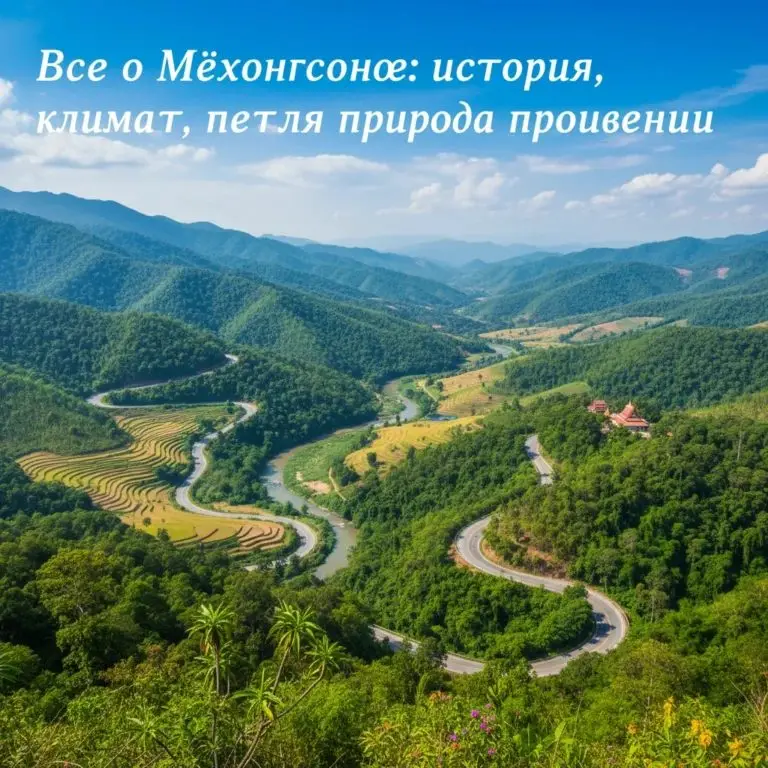
The Mae Hong Son loop is a large circular route through the north of Thailand, which usually begins and ends in Chiang Mai. In essence, this is not a single attraction, but a whole road journey through mountainous areas, most often about 600 km in length. In the classic version the route passes through Pai, the city of Mae Hong Son, and Mae Sariang, and some travelers add branches through Mae Chaem or Doi Inthanon.
It is called a “loop” because the road forms a closed circle: you set out from Chiang Mai, make a large ring through the mountains, and return back to Chiang Mai. This route is especially famous for its beautiful northern landscapes, mountain roads, villages, temples, and viewpoints. The Mae Hong Son region itself is located in a deep valley among high mountains and has historically been considered rather isolated precisely because of the difficult winding roads.
Most often the Mae Hong Son loop is done as a road trip: on a bike, a car, or more rarely with transfers by minivans and buses. It is especially popular with those who love motorcycle travel, because the route is famous for its large number of turns and a very picturesque road. In practice, people usually allow from 4 days for it, and a calmer format — 5–7 days and longer, in order not just to drive, but to stop in Pai, Mae Hong Son, and other points along the way.
To put it quite simply, the Mae Hong Son loop is one of the most famous circular routes in Thailand for a trip through the mountains of the northern region, and not a separate city or park. It is a way to see several places at once in one journey: Chiang Mai, Pai, Mae Hong Son province, small northern towns, mountains, waterfalls, and sometimes Doi Inthanon.
Are there tigers in Mae Hong Son?
Tigers in the province of Mae Hong Son is a topic that often arouses interest, but the answer is not as obvious as it seems.
Historically, tigers really did inhabit the north of Thailand, including the mountainous and forested areas to which Mae Hong Son belongs. This region is covered with dense forests and borders on Myanmar, so theoretically it is part of the wildlife habitat range. However, today the situation has changed: wild tigers in Mae Hong Son are extremely rare and are not considered a common occurrence. If they exist at all, then in very small numbers and in hard-to-reach zones, where tourists usually do not end up.
The main tiger populations in Thailand are now concentrated in large protected areas, such as the western forest complexes (for example, Huai Kha Khaeng). Mae Hong Son is not among the main regions where one can count on their presence.
At the same time, it is important not to confuse: in Thailand one can see tigers in special parks and zoos, but this is not wild nature. In Mae Hong Son province itself there are practically no such well-known tiger parks as in Chiang Mai or other tourist zones.
The conclusion is simple: in the wild nature of Mae Hong Son tigers may exist theoretically, but for the tourist this is rather a rare and almost unattainable encounter.
How to get to Mae Hong Son?
You can get to the province of Mae Hong Son in several ways, but in practice almost all routes come down to three main entry points: through the city of Mae Hong Son, through Pai, or through Mae Sariang. This is a mountainous and remote province in the north of Thailand, so a trip here almost always requires either an internal flight or a long road along the serpentine mountain roads. That is precisely why, when planning, it is important first to understand which part of the province you want to reach, and only then to choose the route.
How to get to Mae Hong Son from Bangkok
From Bangkok to Mae Hong Son people usually travel in three main ways. The first option is a direct flight, if there is a flight on the required date. This way is the fastest and most comfortable, especially for those who do not want to spend many hours on the road. However, direct flights to the northern regional destinations are not available every day and are not always affordable at a convenient price, so they are better checked in advance.
The second option is a night bus from Bangkok. This is a more budget-friendly way, which suits those who tolerate long journeys normally. Usually the bus departs in the evening and arrives in the morning. Such a route is convenient in that it allows you not to spend a separate day on the road, but you need to take into account that the journey is long and tiring.
The third option is to first get from Bangkok to Chiang Mai, and from Chiang Mai to travel further toward Mae Hong Son. This is one of the most versatile ways, because Chiang Mai is easy to fly to, reach by train, or by bus, and from there the choice of ground transport is much wider.
How to get to Mae Hong Son from Chiang Mai
Chiang Mai is considered the main gateway to Mae Hong Son. It is precisely from here that tourists most often build a route who want to reach this province without unnecessary complications. From Chiang Mai you can travel to Mae Hong Son by minivan, bus, rented car, or bike, if you have experience driving on mountain roads.
There are two main overland routes. The first passes through Pai. This is a shorter road, but it is precisely the one known for its large number of sharp turns and serpentines. This route is often chosen by travelers who want to combine the trip with a stop in Pai. The second route passes through Mae Sariang. It is longer, but it may be more convenient for those who want to enter the province from the southern side or to spread the road over several stages. For most tourists, it is precisely the link Chiang Mai — Mae Hong Son that remains the most reliable and clear option.
How to get to Mae Hong Son via Pai
Pai is one of the most popular intermediate points on the way to Mae Hong Son. Moreover, it is itself located in this same province, so many travelers first go from Chiang Mai to Pai, spend several days there, and then continue the journey to the city of Mae Hong Son. Such a route is especially liked by those who do not want to cover the whole road in one long ride.
From Pai to the city of Mae Hong Son minivans and buses usually run. The road takes several hours and passes through beautiful mountain sections. This option is good in that it allows you to gradually immerse yourself in the atmosphere of the province and to make the journey not just a transfer, but a full-fledged part of the route.
How to get to Mae Hong Son from Chiang Rai and other northern provinces
If you are in Chiang Rai or in another northern province, then most often it is more convenient to first get to Chiang Mai, and only then travel to Mae Hong Son. Direct options between Chiang Rai and Mae Hong Son are rare, and public transport usually involves transfers. Therefore, the most logical solution becomes the route through Chiang Mai.
The same principle works for many other northern destinations. Instead of looking for a complicated direct route, it is usually easier to first reach a major transport hub, and then move toward Mae Hong Son along a proven scheme.
How to get to Mae Hong Son from Phuket, Krabi, Samui, and the southern provinces
From the southern provinces of Thailand people usually do not travel directly to Mae Hong Son. If you are in Phuket, in Krabi, on Samui, in Surat Thani, or at other southern points, then the most convenient way is to first fly to Chiang Mai or Bangkok. After that the route continues already through the northern part of the country.
Most often it is more convenient to fly precisely to Chiang Mai, because it is closer to Mae Hong Son and provides a simpler overland transition. The option through Bangkok is also possible, especially if there is no suitable flight to Chiang Mai. In this case the tourist usually either transfers to an internal flight or takes a night bus.
How to get to Mae Hong Son from the eastern and northeastern provinces of Thailand
If you are traveling from Pattaya, Chonburi, Udon Thani, Khon Kaen, Nakhon Ratchasima, or other eastern and northeastern regions, then the logic will be the same. First you need to reach a major transport point, usually this is Bangkok or Chiang Mai, and only then move toward Mae Hong Son. Direct routes between such provinces and Mae Hong Son are rare and usually turn out to be inconvenient in terms of time.
Therefore, for most tourists from these parts of Thailand the optimal way looks like this: first an internal flight or bus to Bangkok or Chiang Mai, then a transfer to a bus, minivan, car, or plane to Mae Hong Son.
Which route to choose if you want convenience
If the main thing for you is comfort and saving time, then it is better to first look at the option with a flight. The plane is especially convenient for those who want to quickly find themselves in the city of Mae Hong Son and not waste energy on long mountain journeys. If there is no direct flight, the next most convenient usually becomes the route through Chiang Mai.
But if you want not just to get there, but to make the journey itself part of the trip, then the best option is to travel through Pai or to build a longer circle through the north of Thailand. Such a route allows you to see more nature, small northern towns, and mountain roads, and the journey itself becomes more eventful.
What is important to take into account before the trip
The main feature of the road to Mae Hong Son is the mountainous terrain. Many routes pass along winding roads with a large number of turns, so those who get carsick should prepare in advance. It is also important to take the season into account: in the rainy months a journey overland may be less comfortable, while in the cool season the road is usually tolerated more easily.
In addition, it is worth remembering that Mae Hong Son is not a destination one usually reaches by chance or spontaneously for one evening. A trip here is better planned in advance, especially if you want to combine several points within the province, for example Pai, the city of Mae Hong Son, and Mae Sariang.
Tips: The roads are mountainous, take an anti-nausea remedy. Book tickets in advance in season (November–February). Car/motorbike rental on GetYourGuide.
Frequently asked questions (FAQ)
Where is Mae Hong Son located and what is it famous for?Mae Hong Son is the northwesternmost province of Thailand, bordering Myanmar, known for its mountain landscapes, mists, ethnic villages, and the famous “Mae Hong Son Loop” — a winding route with 1864 turns.
What climate awaits tourists in the provinces of Pai and Mae Hong Son?A mountain climate prevails here: from November to February there is cool and dry weather, ideal for traveling, from March to May it is the hot season, and from June to October the rainy season lasts, when nature is at its most saturated with greenery.
What is the “Mae Hong Son Loop” and is it worth driving?This is a legendary 600-kilometer car and motorcycle route that passes through Chiang Mai, Pai, and Mae Hong Son. It is a must-have experience for lovers of adventure, offering breathtaking views of the passes and wild jungles.
What wildlife can be encountered in the vicinity of Pai?The region is famous for its national parks, such as Huai Nam Dang. Here you can see rare birds, wild elephants in reserves, thermal springs, deep canyons, and picturesque waterfalls in their pristine form.