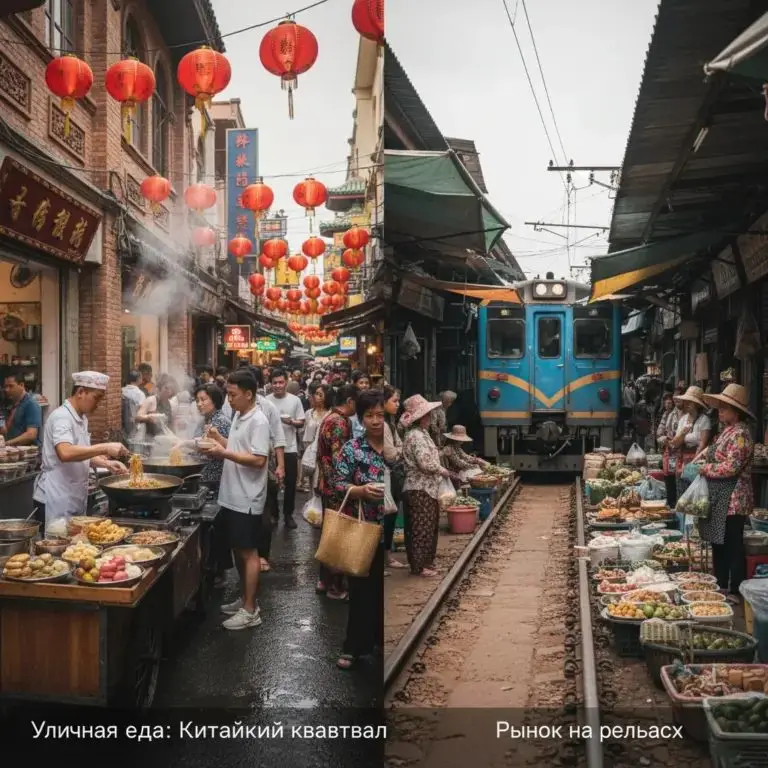
Thailand – is a country where every corner breathes the exotic, but sometimes the choice between two such colorful places can stump even the most experienced traveler. Imagine: a noisy megalopolis pulsing with energy, where the aroma of spices mixes with the honking of tuk-tuks, and suddenly – silence, interrupted only by the clang of metal, where a true wonder of technology passes through a lively market. Are you beckoned by an authentic gastronomic odyssey through the famous Chinatown (Yaowarat), or do you dream of an unforgettable excursion to the Maeklong market, where life goes on to the rhythm of an approaching train? This choice – is not just a point in your tour, it is a decision that determines your vacation.
Often tourists planning their comparison encounter a slight confusion. Both places offer a unique but completely different experience. Yaowarat – is the heart of Bangkok, its culinary soul, where everyone can find something to their taste: from street food to refined seafood. Maeklong, meanwhile – is a living example of Thai ingenuity, a place where the market literally gives way to the train, creating a truly surreal spectacle. This choice is especially critical for those who value time and want to extract the maximum from their vacation, because each location offers its own inimitable atmosphere and adventures, incomparable to luxurious resorts.
Whom will you choose?
Chinatown (Yaowarat) VS The Maeklong railway market You have already voted. Thank you! Chinatown (Yaowarat) 50% The Maeklong railway market 50%Pros and cons: Chinatown (Yaowarat)
✅ Pros- Authentic Asian atmosphere
- Wide selection of street food
- Historical attractions
- Lively nightlife
- Overcrowding, especially in the evening
- It can be difficult to navigate
- Noisy
- Not always clean
Pros and cons: The Maeklong railway market
✅ Pros- A unique experience of watching the train
- Fresh seafood and fruits
- Compactness and convenience
- The chance to see live trade
- Heavily dependent on the train schedule
- Less variety in food compared to Chinatown
- Requires attentiveness because of the approaching trains
- It can be cramped
Yaowarat or Maeklong: Which market to choose?
Choose Chinatown (Yaowarat) if you need an authentic atmosphere and an incredible variety of street food, but head to the Maeklong railway market if you are looking for a unique experience with live observation of how the vendors clear away their goods before the passing train.
Comparison of Chinatown (Yaowarat) and the Maeklong railway market
Yaowarat and Maeklong: A Culinary Alliance or a Battle of Budgets?
Yaowarat and Maeklong — are two famous gastronomic destinations of Thailand that travelers interested in street cuisine and local markets often compare. Although these places are located relatively close to each other, their atmosphere, culinary traditions and price level differ noticeably. That is precisely why many tourists have a question: do they form a kind of culinary union, complementing each other, or does a real "battle of budgets" exist between them for the title of the most accessible gastronomic experience.
Yaowarat — is the historic Chinatown of Bangkok and one of the most famous places for street food in all of Asia. In the evening the main street of the district turns into a huge open-air gastronomic market. Thousands of people come here to try dishes of Chinese-Thai cuisine, which are cooked right before the eyes of visitors. Huge woks of noodles, fried seafood, duck soups, roasted chestnuts, sweets and fresh fruits create a true culinary theater. Many stalls have operated for decades and pass recipes from generation to generation, which is why the district has long become a symbol of the gastronomic culture of Bangkok.
However, the popularity of Yaowarat gradually affects prices. Because of the constant flow of tourists and the reputation of the "capital of street food", the cost of some dishes here can be higher than in ordinary districts of the city. This especially concerns the famous stalls that gained fame thanks to culinary guidebooks and international reviews. Nevertheless, even with the heightened interest of tourists, Yaowarat remains a relatively accessible place for gastronomic discoveries. Here you can find both inexpensive dishes at small food carts and more expensive seafood or signature desserts.
Maeklong represents a completely different type of gastronomic space. This small town is located approximately an hour and a half from Bangkok and is known for its unique railway market. The trading rows are arranged right along the railway tracks, and when a train approaches, the sellers quickly fold the umbrellas and clear away part of the stalls, allowing the train to slowly pass through the market. After it passes, trade instantly continues. This spectacle attracts tourists from all over the world and turns the market into one of the most unusual attractions of Thailand.
From a culinary point of view, Maeklong remains a much more traditional and local market. The main part of the trade is oriented toward local residents. Here fresh fish, shrimp, crabs, vegetables, spices and ready-made dishes of home-style Thai cuisine are sold. Thanks to the fact that the market is not an exclusively tourist place, prices for many products and dishes remain lower than in the popular districts of Bangkok. Travelers who come here often note that the food at the market seems more "home-style" and authentic.
The difference between these two places is well noticeable also in the atmosphere. Yaowarat — is a bright, noisy and constantly moving gastronomic center of the megalopolis. The lights of neon signs, the thick aroma of fried noodles and seafood, loud conversations and queues at the famous stalls create the feeling of a large culinary festival. Maeklong, by contrast, looks calmer and more provincial. Here the life of the market is subordinated to the rhythm of the trains and the customary way of life of the local residents, and the atmosphere is more reminiscent of a traditional Thai bazaar.
If we consider these places as a "battle of budgets", Maeklong more often wins in terms of accessibility. Here you can try dishes and products at lower prices, since the market preserves a local character and is less oriented toward the tourist flow. Yaowarat, meanwhile, wins in variety and the scale of the gastronomic experience. Here dozens of cuisines and recipes are represented that shaped the culture of the Chinese diaspora of Bangkok over the course of many decades.
In reality many travelers perceive Yaowarat and Maeklong not as competitors, but as a kind of culinary union. These two places show different sides of the gastronomic culture of Thailand. Yaowarat demonstrates the bright and cosmopolitan cuisine of the big city, where Chinese traditions intertwine with Thai recipes. Maeklong, in turn, reflects the simpler and more everyday cookery of provincial markets, where food is prepared for the local residents and preserves traditional flavors.
That is precisely why many gastronomic journeys through central Thailand include both destinations. First tourists immerse themselves in the noisy and rich atmosphere of Yaowarat, trying dozens of dishes from the street cooks, and then they head to Maeklong, to see the unique market and try dishes that are closer to the everyday cuisine of the Thais. Together these two places create a more complete picture of the gastronomic culture of the country and show how diverse the street food of Thailand can be.
Atmosphere and Impressions: A Clash of Worlds at Yaowarat and the Maeklong Market
A central place in the magic of Bangkok is occupied by its lively markets, and the two most vivid representatives, Yaowarat (Chinatown) and the Maeklong railway market, offer completely different but equally captivating journeys. If Yaowarat – is the pulsing heart of Chinese culture, where the aroma of spices mixes with the smell of fried duck, and neon signs create the atmosphere of an eternal celebration, then Maeklong – is a place where life itself races against time. Unlike the endless bustle and noisy commerce of Yaowarat, where every corner shouts about its goods, Maeklong astonishes with its unique discipline. Here, amid a variety of the freshest seafood and exotic fruits, the rhythm of life is set by rare trains, forcing the traders to instantly fold up their stalls in order to then just as quickly return to their places. This is a truly mesmerizing spectacle, evoking an instant wow effect, for the sake of which tourists from all over the world gather here.
From the point of view of atmosphere, Yaowarat offers a more classic but no less impressive experience. The crowds of people flocking here for authentic Asian cuisine and colorful souvenirs create the feeling of immersion in a seething ocean of life. Here, of course, it can be hot and cramped, especially in the evening, when the street cafes fill the sidewalks, but this physical closeness and energetic saturation – is part of its charm. Whereas Maeklong – is more about pure astonishment and the moment. Its value lies in the uniqueness of the situation: to see how the setting literally changes before your eyes – is an experience that will be remembered for a long time. The absence of such large crowds as at Yaowarat allows you to examine the goods better and communicate with the local residents, although it offers fewer options for gastronomic adventures compared to the culinary Mecca of Chinatown.
If Yaowarat – is a journey through time and culture, where the history of the Chinese diaspora of Bangkok is felt in every building and every dish, then Maeklong – is rather a sharp moment frozen in time, a demonstration of astonishing adaptation and ingenuity. The amenities at Yaowarat are, as a rule, oriented toward the mass tourist, with a large number of restaurants and shops. Maeklong offers more spartan conditions, where the emphasis is placed on the freshness of the products and the unique trading process itself. Both places are worth visiting, but the choice depends on whether you are looking for the seething energy of urban life or a moment of pure, genuine delight bordering on the absurd.
From Yaowarat to Maeklong: a battle of transfers in Bangkok
When it comes to immersion in the authentic atmosphere of Bangkok, two names surface in the memory of travelers: the seething Chinatown Yaowarat and the unique Maeklong railway market. But how convenient are the transfers to these colorful places, and which option is preferable for lovers of comfort, speed and safety? Unlike Yaowarat, where you can get relatively simply, using numerous taxis, tuk-tuks or even water transport along the Chao Phraya River, Maeklong requires more thought-out logistics. If here you can allow yourself some spontaneity, then there, to Maeklong, it is worth thinking out the route in advance, often including a combination of a scheduled bus or minivan to the Mahachai station, and then local transport for the final stretch.
The duration of the transfer to Yaowarat, given the absence of traffic jams, can be quite comfortable, taking from 30 to 50 minutes depending on your point of departure in the city. The transport there is, as a rule, more varied, and you will easily find a taxi with air conditioning or a boat, avoiding the exhausting heat. Whereas a trip to Maeklong, even under favorable conditions, will take significantly more time, often from 1.5 to 2 hours, and sometimes more, considering the need for transfers and possible delays. The question of safety also takes on a different hue: in the well-lit and lively Yaowarat you feel more confident at any time of day, whereas travel through remote districts to Maeklong, especially in the evening, may require increased vigilance.
When it comes to comfort, Yaowarat undoubtedly wins. Here you can choose a taxi with air conditioning, minimize the waiting time and enjoy a relatively smooth ride. If, however, your choice fell on Maeklong, be ready for a more adventurous journey. Most likely you will have to use public transport, which may be overcrowded, not always equipped with air conditioning, and the journey itself along busy roads and narrow streets may turn out to be more tiring. Thus, if the main criteria are speed, convenience and predictability, then a transfer to Chinatown will be more preferable. For seekers of adventure and those who are ready for longer and less standard trips, the Maeklong railway market will open up as a unique but more labor-intensive destination in terms of logistics.
The Final Choice: Yaowarat Or Maeklong – Which Market Will Steal Your Heart?
So, before you is a dilemma that may determine the taste and impression facets of your journey. Chinatown Yaowarat beckons with its seething life, aromas and diversity. This is a place where history meets modernity, and every corner breathes adventures.
The Maeklong railway market, by contrast, offers a unique and captivating experience that is hard to find anywhere else. This is not just a market, it is a dynamic performance, where time goes by the schedule of the freight trains.
- Choose Chinatown (Yaowarat) if you are: a true gourmet, thirsting to plunge into the culinary heart of Bangkok, a connoisseur of the atmosphere of noisy streets and bright lights, a lover of exploring narrow alleys in search of authentic flavors and souvenirs, as well as someone who is ready for a true gastronomic adventure that lasts until late at night.
- Choose the Maeklong railway market if you are: looking for a truly unusual and memorable spectacle, love adrenaline and sharpness of sensations, prefer to observe unique rituals and interaction with local life, as well as ready for short but vivid impressions that happen more rarely but leave an indelible mark.
Frequently asked questions (FAQ)
What is street food in Chinatown?Street food in Chinatown — is authentic dishes prepared by local residents in traditional stalls and mobile carts. Here you will find a wide selection of flavors, from spicy dumplings to aromatic soups.
Where to find the best street food in Chinatown?Look for the best street food on the lively streets and in the alleys of Chinatown, where local residents and experienced tourists prefer to cook. Don't be afraid to experiment and try what looks most appetizing.
How does the 'Railway Market' differ from Chinatown?The Railway Market — is a modern concept of a gastronomic space, often located in unusual locations, for example, under railway bridges. Here the emphasis is placed on stylish presentation and varied cuisines, often with a trendy interior.
What street food is popular at the 'Railway Market'?At the 'Railway Market' you will find both classic and signature dishes, often with a European and Asian fusion. These can be unusual burgers, creative rolls, gourmet tacos and exotic desserts.
Chinatown or the Railway Market: what to choose for the first time?If you want to immerse yourself in the authentic atmosphere and try real Chinese delicacies, choose Chinatown. If you are looking for a trendy place with varied gastronomic trends and a stylish setting, then the 'Railway Market' will suit you better.
What dishes are a must-try in Chinatown?Be sure to try dim sum, crispy Peking duck, wok noodles and various kinds of fried rice. Don't forget also to experiment with the local sweets and tea.
What is special about the food at the 'Railway Market'?The special feature of the food at the 'Railway Market' — is in its multifacetedness and creativity. Here signature versions of popular dishes are often presented, prepared using fresh and unusual ingredients.
Is it safe to eat street food in Chinatown?As a rule, street food in Chinatown is safe, especially in places with a large flow of visitors. Pay attention to cleanliness, the freshness of the products and the methods of preparation.
Are there vegetarian/vegan options at these markets?In Chinatown you can find vegetarian options, for example, vegetable dim sum or fried rice without meat. At the 'Railway Market' vegetarian and vegan dishes are represented much more widely and often have a separate menu.
How much does street food cost on average in these places?The cost of street food varies, but on average it is more accessible than in restaurants. In Chinatown you can have breakfast or lunch for relatively little money, whereas at the 'Railway Market' prices may be higher because of the originality of the dishes and the setting.