Where do the three schools actually stand?
The first thing to settle is not the price but the address. High Surf & Kite School stands on the beach of Long Beach Resort on the Sahl Hasheesh road, south of central Hurghada. Paradise Kitesurf Red Sea and Kite School Egypt both sit in the flat lagoon between Hurghada and El Gouna, roughly 20 to 30 kilometres north of the centre.
Neither of the two northern schools is in the city, and the drive is yours to plan — none of the three includes a transfer in the price.
One student or two — what changes?
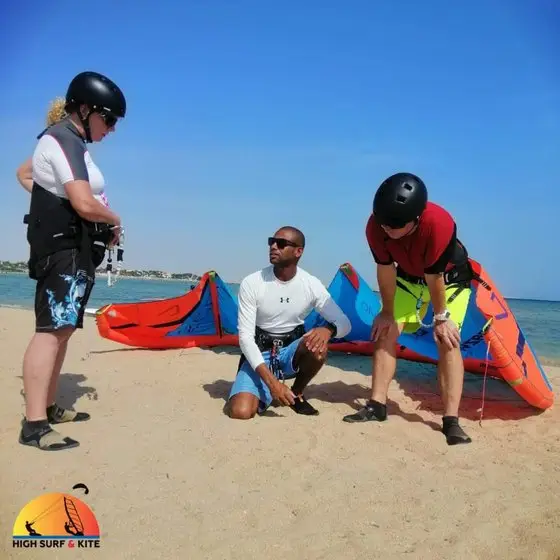
Then decide whether you want the instructor to yourself. A private lesson is one student and the whole session; a shared lesson is two students splitting both the instructor and the time on the kite. That is why €440 per person buys eight private hours and €360 per person buys eight shared ones: you are paying for attention, not for a different sport.
How many hours do you need?
The hour count is what actually decides whether you leave riding. Two hours at Kite School Egypt is a taster — enough to fly a kite on the beach and know whether you like it. Eight hours at Paradise is a beginner course with an IKO certificate at the end.
Fifteen hours over four days is the format the schools themselves describe as the road to riding independently, and Kite School Egypt does not charge for hours you do not use or for days without wind.
What is not in the price?
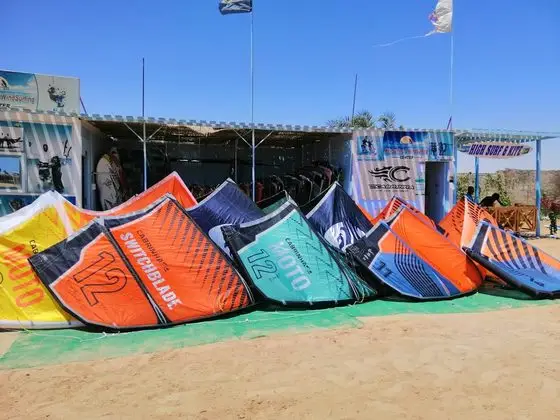
Gear and its insurance are inside the High Surf and Paradise prices; with Kite School Egypt, ask what the course price covers when you book.
High Surf also hands out an IKO certificate free of charge on lessons of 12 to 15 hours, plus 15% off gear rental afterwards.
Important
Your own travel insurance is outside the price everywhere. High Surf names it explicitly and recommends a policy that covers kiteboarding as an extreme sport, and Paradise lists travel insurance, accommodation, flights, meals and the entry visa outside the price.